By Píter Ortega Núñez
PORTICO
The pictorial production of the young Cuban artist Tony Rodríguez (Juan Antonio Rodríguez Olivares, Santiago de Cuba, 1980) rises around a fundamental thematic nucleus: the universe of the journey. The characters in the artist’s work are eternal passersby, tireless travelers. They experience perpetual nomadism, a constant displacement (both physical and symbolic). Stability and permanence have no place in their narratives. The interesting question would be: What are these beings searching for? Where are they heading? What is the ultimate purpose of their journey? What is their goal? Why are they so passionate about movement?
CHIMERAS
More than a physical journey, it is probably a fictitious, utopian voyage—a never‑ending pursuit of dreams, aspirations, and desires by these tireless little men on the move. Like Don Quixote, these characters are romantic warriors, justice‑seekers filled with courage and profound ethics. Thus, they set themselves to conquer the sea, to surpass the earthly borders that imprison them, to taste the so‑called American dream, to challenge a new world order. Or to defy the sun—like Icarus—to discover the day after tomorrow. To conquer space, to survive with “strange forms.” To fight for their freedom and fulfillment. Their main weapon: faith, confidence in the infallible law of attraction, the certainty that the human mind governs everything, and that a thought repeated a thousand times becomes a truth.
SYMBOLS
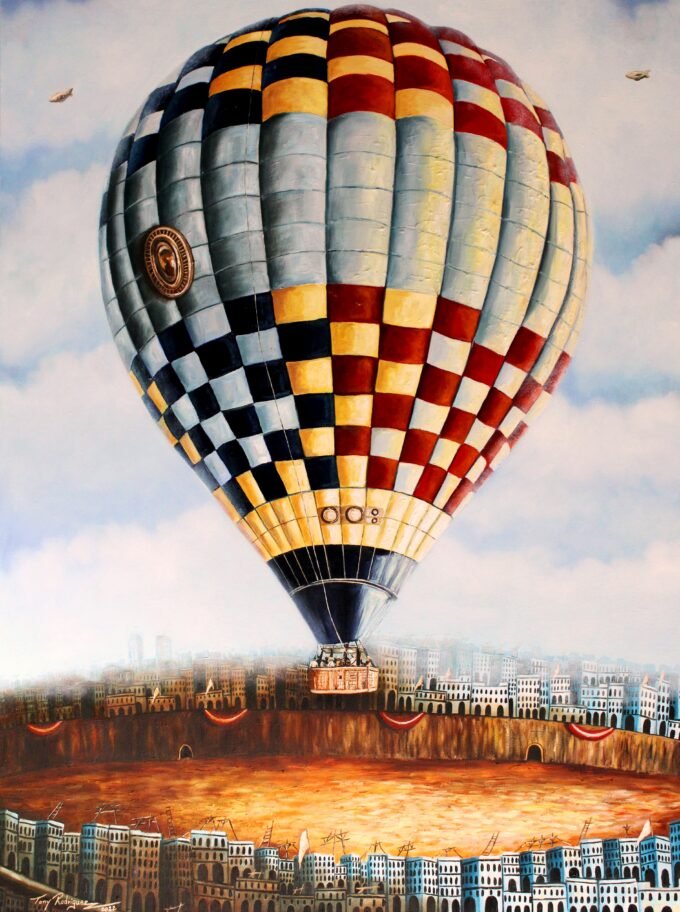
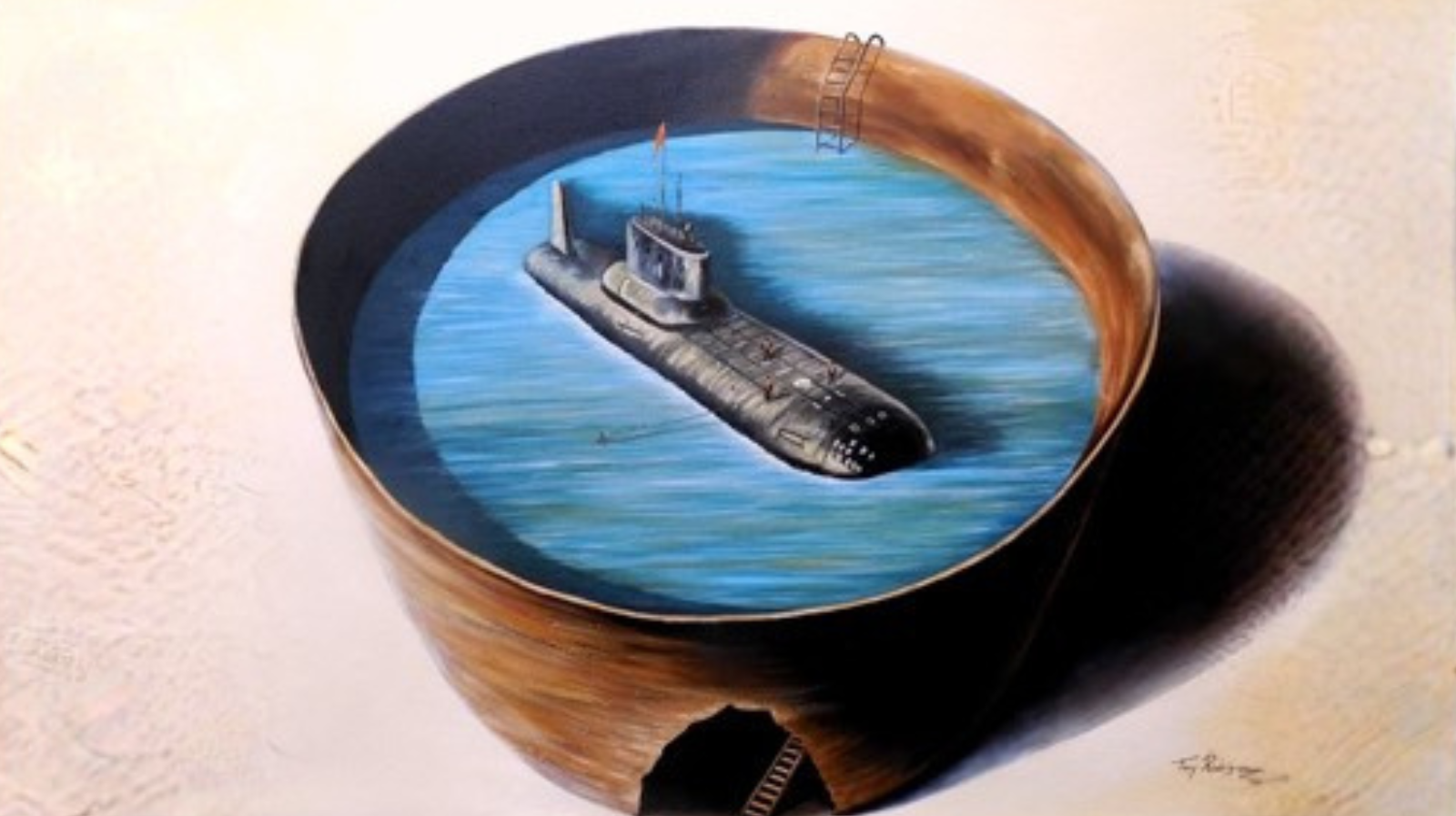
In relation to the above, the creator uses certain iconographic symbols of undeniable effectiveness and visual poetry: windmills, boats, wheels and propellers, clocks, hot‑air balloons, floating—mobile—islands, tractor tires, apples, cities and their architecture. Most of them allude to transit, to the exchange of spatial relationships. Icons of visible theatricality, as if they were stagings of apocryphal narratives. The author brings together historical moments and divergent geographic settings with a freedom of association and metaphorical scope that are deeply enjoyable.
TIC TAC
Another constant in the work of Tony Rodríguez is the theme of time and memory. In his pieces, temporal logic is diffuse, complex, and distant from the way we understand it in our everyday interactions. The artist’s clocks mark a time different from ours. They are whimsical, capricious. Unstable. Their time is fractal. To enter the author’s poetics implies traveling to the past and the future with the same intensity—and sometimes both journeys occur, curiously, at the same time. This means going back or forward hundreds, thousands of years. A titanic task, yet seductive and fascinating. Tony’s iconography makes us disconnect, fly into the void, project our minds toward the most unknown corners of the universe, and return satisfied (with many questions, but happy).
TIC TAC
Another constant in the work of Tony Rodríguez is the theme of time and memory. In his pieces, temporal logic is diffuse, complex, and distant from the way we understand it in our everyday interactions. The artist’s clocks mark a time different from ours. They are whimsical, capricious. Unstable. Their time is fractal. To enter the author’s poetics implies traveling to the past and the future with the same intensity—and sometimes both journeys occur, curiously, at the same time. This means going back or forward hundreds, thousands of years. A titanic task, yet seductive and fascinating. Tony’s iconography makes us disconnect, fly into the void, project our minds toward the most unknown corners of the universe, and return satisfied (with many questions, but happy).
ART HISTORY
Another thematic line of interest for the artist is revisiting the past of Art History through homage and reinterpretation of some of its classics. This occurs, for example, in his appropriation of the celebrated work “The Origin of the World” by Gustave Courbet, which he titled “Courbet and I.” In Tony’s version, the erotic component is heightened due to the inclusion of small male figures (perhaps the artist himself?) over the famous female torso, like tiny men curiously exploring the erogenous zones. At the same time, the architectural and urban background adds greater charm to the piece.
Equally interesting is his reinterpretation of Leonardo Da Vinci’s “La Gioconda,” which he named “Monna Lisa Rastafarian XXI Century.” Both interesting and humorous. In this case, the artist uses a symbol characteristic of certain twentieth‑century urban countercultures (Rastafarian dreadlocks) and places them where the Mona Lisa’s hair would be, in a playful and subversive gesture that greatly seduces me. This Mona… is a hippie, an art‑world rebel, a transgressor of historical protocol—an authentic postmodern reinterpretation. A legitimate homage filled with humor, but with multiple cultural and social readings. A fusion of high and low culture, elite and mass culture. A process of cultural trivialization, the desacralization of models once considered “sacred” within modern tradition.
BLUE, ALWAYS BLUE
Another essential protagonist in Tony’s work is the sea, the omnipresent ocean that populates and dominates everything. A sea almost always furious, stormy, speaking to the characters like dark omens, announcing difficult events and painful journeys. Something like the cursed circumstance of water everywhere.
In this direction, the artist’s works address a theme that remains heartbreaking for many lives: migration, the exodus in precarious boats, with all the imagination and popular creativity behind it. A migration that does not cease, that continues to claim numerous lives in the attempt. “Estado de sitio,” “En busca de la libertad,” “La ciudadela,” “¿Por qué pedid ayuda, acaso no tienen fe?”, “Navegando,” “Solo la fe salva,” “Mare Nostrum,” “Atrapados”… are pieces in which the migrant experience is presented as an unresolved problem, the beginning of a tragedy of great magnitude.
Particularly revealing is “Estado de sitio,” where the city and its people are trapped within the circularity of their own journey, in the nullity and ineffectiveness of a voyage that will always lead back to its starting point. An iron circle beyond which there seems to be no human life, but rather arid, inhospitable, desert land. The pneumatic device that should have served as an agent of salvation and passage has become the very prison of the crew. A sharp parable of the journey as inconvenience, as limitation, as consummated failure. As disillusionment.
THE ISLAND
Parallel to—and intimately connected with—the metaphors of the sea, the subject of insularity appears in the author’s production. As a good Cuban, this theme could not be absent in his creations. His works are full of islands everywhere: static islands, wandering islands, flying islands, imprisoned islands… The possibilities are endless, just like the artist’s poetic ability to associate. Little homelands where dreams germinate—and fade. Lands of adventures and disappointments, utopias and disenchantments. Beautiful works, in short, endowed with remarkable human depth.
THE NEW ORDER…
Without a doubt, one of the most paradigmatic paintings in the creator’s career is “The New World Order” (2012). It conveys an extraordinarily beautiful message. The scene is composed of a circular city whose structure immediately recalls the Roman coliseum. At the center, a figure delivers a speech to the masses, while behind him there is a landscape painting. What does the artist want to tell us with these symbols? Probably that, in the face of a “new” world order of barbarism and monstrosities, of circuses and inhuman gestures, art will be the path toward salvation, toward the redemption of the human species. That individual must be giving a talk about peace, a discourse of love and nobility—so necessary in our times. And how wonderful that his fundamental tool of persuasion is art, that straight path to the nobility of the spirit. In these times of excessive violence and death, of so much unnecessary war, a painting like this feels incredibly wise—conciliatory and altruistic.
NOTHING TO SAY
Equally lucid and provocative is the canvas titled “El discurso” (2009). In this case, we see the same circular city structure evoking a Roman arena. At the center, a podium with two microphones, with the essential difference that the speaker is completely absent. A metaphor that becomes truly overwhelming. Is it that no one dares to stand as a preacher? What are they afraid of? Why is the leader absent? The city has lost its orator, its messenger—something grave in times when the word is essential for building more democratic and just worlds. Meanwhile, curiously, near the podium there is a large group of books, abandoned and scattered. What is the meaning of this relationship between spoken and written word? Could it be that the would‑be speaker, after so much reading and erudition, has lost the will to speak? Who knows. For now, the work leaves me thinking—and that is a comforting sign.
WHAT THEY TAUGHT US
Another piece deserving special attention is “Lo que nos inculcaron” (2009). This reflection centers on the myths through which certain macropowers instill behavioral models and heroic archetypes in individuals and social groups—fables often built on falsehood and disguise. The work focuses on the precise moment in which we begin to suspect what we were “persuaded” to believe. It addresses the clarity that illuminates the subject once he decides to free himself from hegemonic dictates. It makes us reflect on the importance of the instant of doubt.
NAMING THINGS
In addition to his pictorial craftsmanship (mastery of drawing, chiaroscuro, perspective, use of color, etc.), Juan Antonio stands out for his skill in titling his works—most of them marked by strong poetic impulses. His titles are decisive in fully grasping the range of meaning within his creations. Proof of this are some such as “El gremio de los inconsultos,” “Abraham Lincoln explaining to a farmer about the American dream,” “The day after tomorrow,” among others.
EPILOGUE
Recently, in a conversation with the artist, he told me he does not like to be valued only for his pictorial technique—what interests him most is the reflection, the thought hidden behind each stroke. And I believe, after analyzing his trajectory closely, that he is absolutely right. For Tony, the signifier is never an end in itself but the channel through which multiple meanings of great intellectual depth are reached. More than for the retina, his canvases are a challenge to reason. Which is greatly to his credit.
Then, keep going, my friend. The truth is on your canvases.