By Andrés Isaac Santana
When the full moon arrives
I will go to Santiago de Cuba.
I will go to Santiago
in a coach of black water.
I will go to Santiago.
Palm-thatched roofs will sing.
I will go to Santiago.
When the palm wants to become a stork.
I will go to Santiago.
And when the plantain wants to become a jellyfish.
I will go to Santiago.
With the blond head of Fonseca.
I will go to Santiago.
And with the rose of Romeo and Juliet
I will go to Santiago…
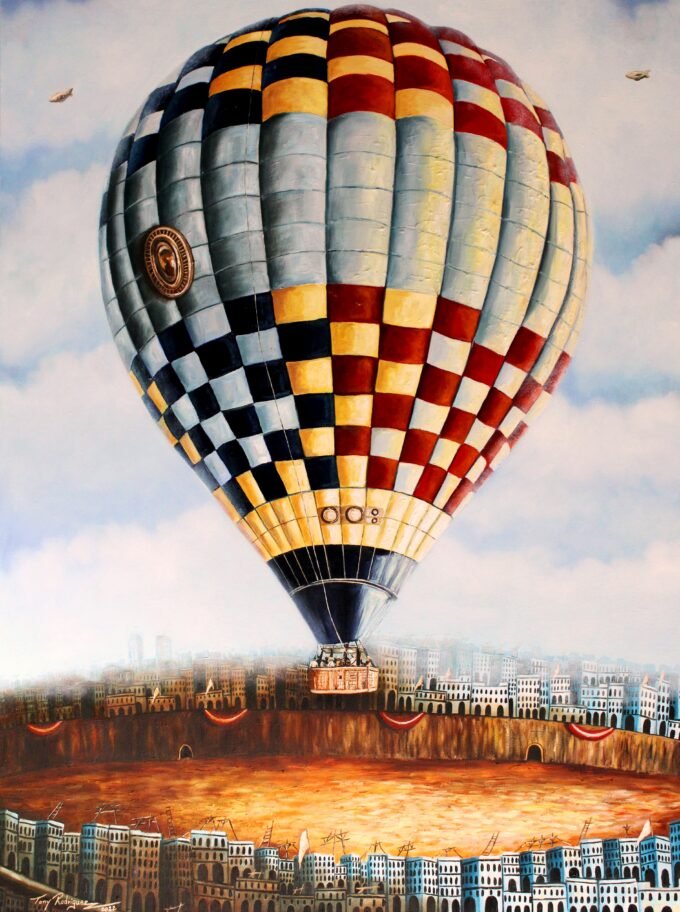
We would have to wait for a much bolder and more visionary critical discourse before the current one could shed its fatum of decadence and begin to engage in amorous exchanges with every kind of poetics. Traditional criticism would rush to label this artist within a context of associated references—tendencies or styles—obvious to all, known by everyone. But since I do not belong to that school of formulaic, stale, and obsolete prospects, I will not attempt to trace the referential horizon of influences in the work of Juan Antonio Rodríguez, a Cuban artist living in Florida. On the contrary, responding to the very polyhedral nature of the image contained in his work, I will not think of him as the painter already pre-thought and pre-figured by others; I will think of him as the narrator, above all things. If his work reveals a particular mark of identity, it is precisely that of being a narrative text in which holistic reflection and human perturbation constitute the autonomous sources of his specific grammar. The painting matters, of course, but beyond the canvas, what truly interests the artist is the breadth of the story and its infinite thresholds of expectation.
Accompanied by my glass of Ribera del Duero, I observe a broad repertoire of his works. I return to them again and again, trying to understand them, to capture something I believe escapes me—something I cannot fully grasp, but which leads me to think of him as a narrator who paints, or a painter who narrates stories. That critics must sometimes pretend to understand everything does not excuse confessing that one may not understand anything at all. Social modesty often leads to lies, and with them, to the most resounding of fallacies. Not fully understanding is human. Everything I do not know or that eludes my understanding only magnifies, in any case, the heroism of my own fragility. But I insist: I look at Tony’s work, I look at it intently. From that emphatic and subversive gaze emerges the need for text—the almost irrational desire to possess, through written words, the polyvalence of the pictorial sign, its outbursts and reactive gestures. I then discover that terms such as thought, voyage, nomadism, fiction, ideals, transcendence, identity, and space organize the expanded vocabulary through which his poetics are orchestrated.
Among all these terms, voyage, fiction, and intermittent nomadism form a semic triad, becoming the undisputed queen within the thematic context of all his work. Thus, the whole of it could be read as a conclusive pictorial dissection of voyage as a tropological figure. Every piece—or at least most of them—appears traversed by the syndrome of displacement, of coming and going. A movement that, moreover, requires neither destination nor recognizable ports of arrival nor distinct identity thresholds. It is an abstract voyage, a historical voyage, an eternal voyage; it is, in essence, the voyage.
The fact that the artist is Cuban—like myself—invites the obvious critical temptation to frame the interpretation of his discourse under the condition of insularity. Yet such reduction of meaning collapses once we listen to the artist and perceive the ambition of his journey. Tony knows—he knows well—that being Cuban is not a label of added value but merely a designation of origin, with all the cultural (and dramatic) weight that entails. Thus his journey is instead a universal, foundational, utopian narrative. We are not speaking of that familiar story of the Cuban who leaves, a theme already exploited, ritualized, and vulgarized to exhaustion. We speak here of the wandering of cultural processes themselves—of those matters which, being so abstract, often end up defining our universal ontology through a vast text of alchemy.
Regarding the nature of this journey, the young Cuban critic Píter Ortega noted that “perhaps, more than a physical journey, it is a fictitious, utopian voyage—an endless pursuit of dreams, aspirations, and yearnings by these tireless little men on the move. Like Don Quixote, these characters are romantic warriors, justice-seekers brimming with courage and profound ethical strength. Thus they prepare to conquer the sea, to transcend the earthly borders that imprison them, to taste the so-called American dream, to challenge the new world order. Or to defy the sun—like Icarus—to discover the day after tomorrow, to conquer space, to survive with ‘strange forms,’ to fight for their freedom and fulfillment. Their main weapon: faith, trust in the infallible law of attraction, the certainty that everything is governed by the human mind, and a thought repeated a thousand times becomes a truth.” It is clear, then, that the metaphorical dimension of the voyage in this artist’s work goes far beyond insular context and the wide range of allegories it might produce.
This leads me to speculate on a thesis that struck me the very moment I first encountered his work, and which confirms my hypothesis of Tony as a narrator-painter. It is the fact—far from insignificant—that Tony does not live in time, but parallel to time. This, which may sound like rhetoric or sophistry, is vital to understanding the narrative emphasis of his proposal. His work does not allude, as some have attempted, to specific events. Instead, I might even say—with some liberty—that Tony understands history as a sort of rhetorical spell-craft from which one might well dispense, since what matters to him is the narrative dimension, the illusory power of fiction, the founding will, and the desire to tell stories that need not be tied to evidence.
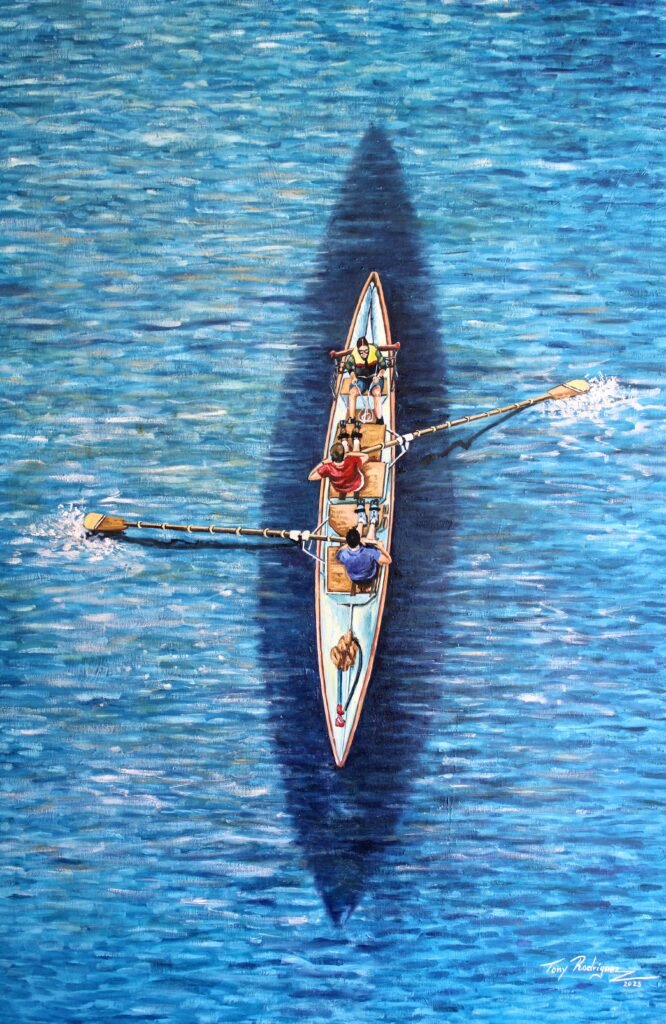
Close to this idea are some conjectures proposed by Cuban critic Antonio Correa Iglesias, who notes that Tony’s painting “is the emphasis of a limbo in which we drift toward a profound solitude. The rending in Juan Antonio Rodríguez’s work is not only the feeling of a dissolving city, a dissolving world; it is, above all, the rupture of ceasing to be—the dissolution of an entity called Man condemned to disappear. Nietzsche said that man’s greatest sin is having been born.” That same limbo and dissolution are, meanwhile, powerful argumentative forces within his work, emphasizing its abstract detachment from concrete, traceable everyday circumstances. Tony is, after all, a thinker—an inquisitive mind with not only academic training but also that which is forged through lived experience. Only one who lives intensely and converses with his demons is able to translate the interlocutions of his errant thought into works of art. Only the one who dares can win; only the one who dreams can fly. Tony is a man who flies—one who once thought of the earth with his feet in the sky, or who traced the stars through the heat of asphalt. His subjectivity is crossed by a recurring idea: movement. A peculiar kind of movement that, as in literature, can alter time, play with infinite juxtapositions, and manage random overlaps. His work constructs narratives that seek—above all seriousness or conceptual gravity—playfulness, expansion, freedom, the demolition and bankruptcy of any ideological tyranny that prioritizes duty to be over being itself.
I do, however, differ from Correa Iglesias regarding the notion of “concealed baroque” in Tony’s work. The critic, with notable sharpness, argues that “the meticulous care for pictorial detail reinforces a baroqueness often concealed. Covering the pictorial space is not an obsession; rather, Juan Antonio Rodríguez saturates his canvas with details to emphasize the crowded and rusty quality of a city that, like its actants, decomposes.” On the one hand, he speaks of concealment; on the other, he recognizes saturation as an active principle of the artist’s surfaces. Perhaps for this reason I am inclined instead toward the understanding of an expansive and stable baroque. From that paradigm, the narrative of his work acquires corporeality through the density of its details. In this case, descriptive action surpasses narrative gesture.
I do, however, differ from Correa Iglesias regarding the notion of “concealed baroque” in Tony’s work. The critic, with notable sharpness, argues that “the meticulous care for pictorial detail reinforces a baroqueness often concealed. Covering the pictorial space is not an obsession; rather, Juan Antonio Rodríguez saturates his canvas with details to emphasize the crowded and rusty quality of a city that, like its actants, decomposes.” On the one hand, he speaks of concealment; on the other, he recognizes saturation as an active principle of the artist’s surfaces. Perhaps for this reason I am inclined instead toward the understanding of an expansive and stable baroque. From that paradigm, the narrative of his work acquires corporeality through the density of its details. In this case, descriptive action surpasses narrative gesture.
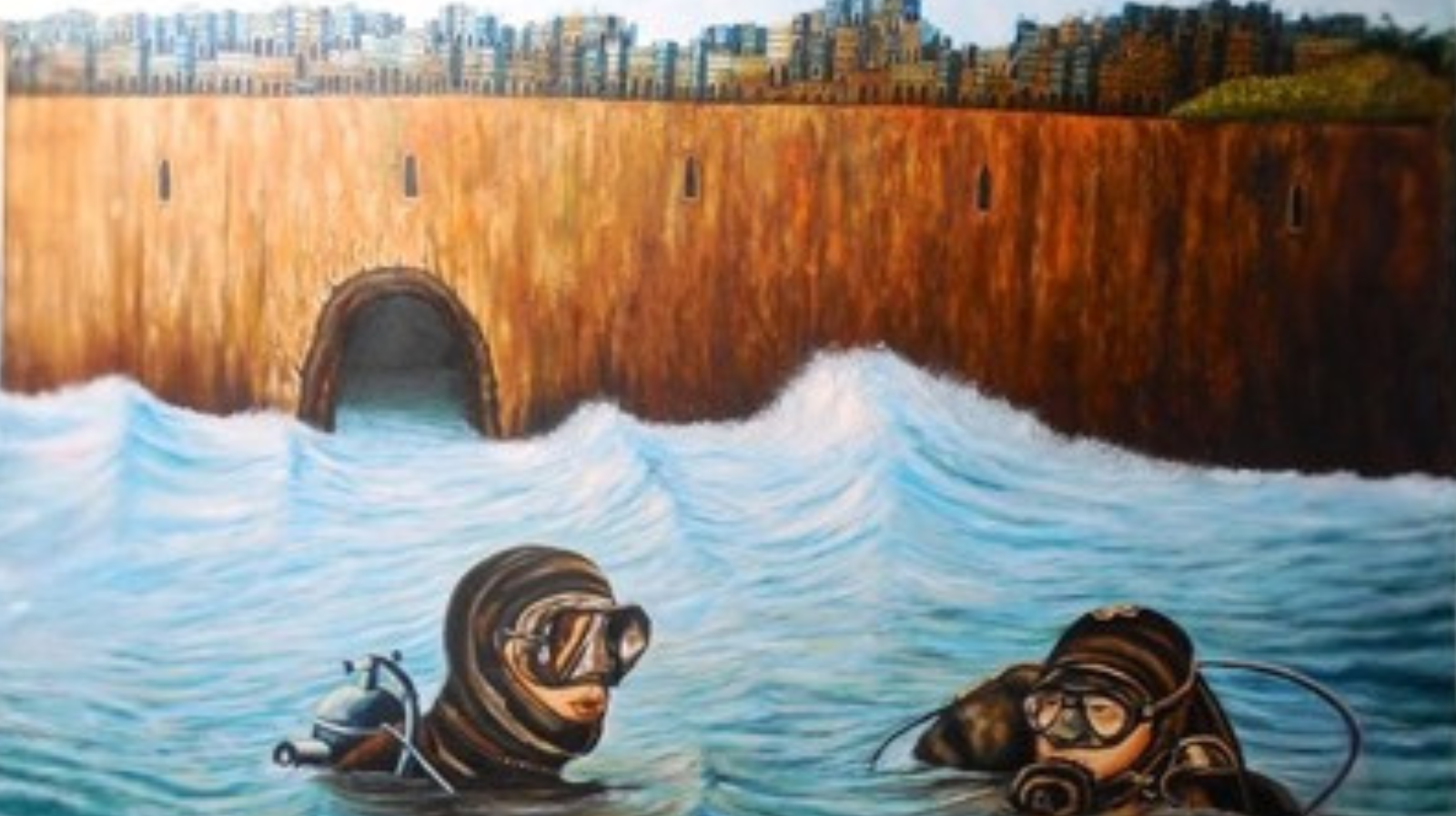
From this baroque impulse emerges a representational strategy in his work that I find truly fascinating, one that affects entirely the notion of parallel time I mentioned earlier. It is his ability to arbitrate moments, scenarios, and situations that are vastly different, distant, and divergent, yet brought into acts of proximity and superposition—something I dare to call an exercise in coexistence. This coexistence translates into a delightful metaphor shared by many other Cuban artists as well. Being floating insular subjects in the Caribbean, yet deeply connected to the Latin American context, invites us to the euphoria of transvestism, to the dance of superpositions, to the game of masquerades and apocryphal narratives. We are compulsive chameleons, changing and baroque beings, creatures who know how to burn life in an instant of pleasure and escape.
All of his iconography, symbolism, and narrative point unmistakably to a surrealist and surrealizing space—a place of otherness. Regarding this surrealist perception, P. Ortega notes: “The artist employs a stylistic operation close to the precepts of surrealist aesthetics, especially in terms of the coexistence of antagonistic worlds, disparate representational spaces, with the intention of generating estrangement rather than analogies. In some works, there is even a direct nod to emblematic figures of that movement, such as René Magritte. The deliriums and fertile imagination of Juan Antonio found in surrealist procedure the perfect channel through which to express his thematic concerns.” The critical precision of this observation cancels the need for extended digression.
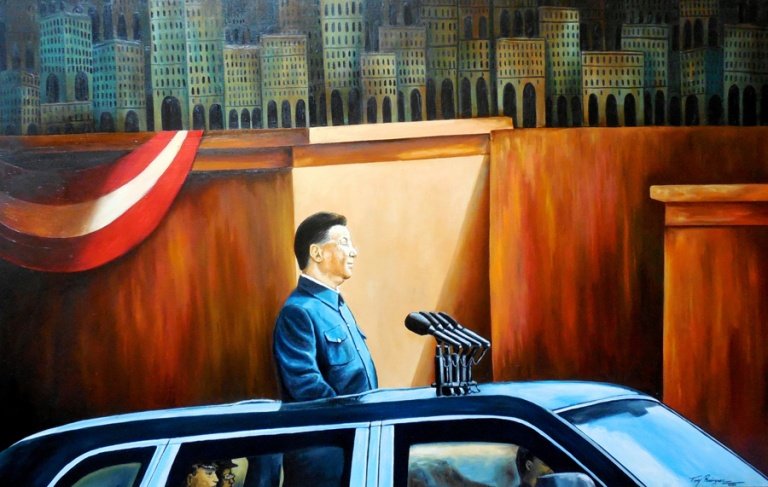
This otherness in Tony’s work—different from that handled by contemporary cultural studies within canonical texts—I understand as a recursive staging of theatricality. His pieces possess a scenographic and theatrical quality that I find compelling. If someone were to tell me they were created to accompany a play or a ballet, I would believe it, without hesitation. Just as the writers of the Latin American post-boom mocked the solemn transcendence of earlier literature, sealing its death with the kiss of a woman who might have been a spider, Tony—an audacious recuperator and contemporary archaeologist of the boom—resurrects from its tomb the cosmic subject who drew for himself, and for his space of reference, a teleological and heuristic image of his culture. While those post-boom writers parody endlessly, basing their strategy on imitation without depth, Tony instead embraces the destiny of his life and writes history without fear of that sentence by Luis Cardoza y Aragón: “the predictions of one era are the repugnances of the next.” Thus, his entire oeuvre, in its almost liturgical communion, strives for a vision that does not require postmodernity as a canon but restores the value and pertinence of a modern essayistic approach in which the beauty of forms and voices need not be disproportionate to the conceptual and discursive force that animates them. From this logic emerges a pictorial project in which audacious connections form between the painterly imaginary and the speculative/narrative formulations generated by the pleasure of his restless and expectant thought.
There is neither contradiction nor disparity in the method employed throughout his narrative. It is always the same: the emancipation of the expectant eye before the topographical accidents of dream landscapes, and the activation of rhetorical detours that grant meaning to the image. This is where those strange architectures and floating, suspended cities appear. A hybrid architecture emerges, inhabited by characters who may or may not be aware of their (mis)fortune. These realms, in Tony’s work, become allegories of the Latin American cubist space, for they contain the proliferating nuclei invoked by Alejo Carpentier while also adhering to the projective fervor of the baroque flight. Hence the volcanic serenity of these images. Their silence and distance are nothing but the celebration of life impulses that inhabit them, hidden behind the specular surface. There is life there—within that space of broad generalizations and near-mystical superpositions, of purification and clinical asepsis. There is life, indeed. A voice traverses these worlds, linking them masterfully to the artisanal and ecumenical grandeur of his canvases. It is there—in that synergy between thought and image—where one of the elevated virtues of his work resides: the fulfillment and epiphany of that protoplasmic enunciation in which narrative and pictorial exercise commune within the same textual space, independent of medium or linguistic speculation. Between these visions lie the programmatic character and structural emphasis that guide his poetics toward their horizons of realization and consummation—hungrily, gravely. The whole work reveals itself as text, as a grammatical structure that assembles each part into the drafting of an almost perfect sentence. Subordination, chiasmus, and amphiboly are not foreign to him, though they are not the most relevant devices in his narrative. The transparency of argumentation and the density of the place of enunciation are the most significant elements. Thus, in this long wandering, Tony rehearses a kind of return to the place of origin.
I look at the pieces closely, pausing with good wine in hand. I probe beyond the surface, seeking the motives that inspired them instead of remaining trapped in what they represent. All of them, in their own way, lead me to that labyrinthine and licentiously poetic space that forms the city and its accidents. They seem like absent cities possessed by the autistic pulse that buries the noise of voices. Paralysed in the time of a distant era where silence is nothing but the triumph of eroticism. I think about the content of these images and then recall Louise Bourgeois’s lapidary assertion: “content is today the erotic message: everything that takes place as a result of the presence of two people. Pleasure, pain, survival, in public or in private, in a real or imaginary world.” Her affirmation redeems me and shifts me. It is clear that I may speculate, that I may turn reading into yet another work. If content is not reduced to what the text says, but emerges from the eroticism of dialogue between one and another, then I need not feel guilt. I need not fear becoming some sort of castrator, violator of another’s subjectivity, a delirious interloper intruding where I am not called. I feel free. I may speculate—I may speculate at will, under the lash of inspiration and the thirst for writing.
Suddenly relieved, I ask myself: was there ever a city, or was the city a dream? Was it—perhaps—nothing but a furtive speculation or the whim of a prophecy of lights? Perhaps a fantasy fluttering between tireless mirrors, perpetuating itself? Or a labyrinth of possibilities where the Minotaur vainly sought the marble gaze of statues that had long gone blind? A mirage, maybe? Perhaps it was all that and more. The magnificent city assisted him, engaged him, disguised its silhouette among encyclopedias, atlases, and the ungraspable hinges of memory. It became evanescent even as it asserted its power as a globalized metropolis of a historical moment seeking to undo its fatum of decadence and exhaustion. It declared its presence like a voice in an opera, yet returned to the surface as the incestuous silence that tattooed the skin and soul of the wandering, terrified tenant.
Those who look quickly, making their gaze gallop before the vertiginous suggestion of this city, fail to notice the emotion it displays. They subordinate it—by default—to form, to the most elemental and extensive grammar of its parts. They cannot. They cannot capture the efficacy of the emotion that permeates it as in the ecstasy of a final symphony. They distract themselves with the disposition of its parts, with the architecture of the syntagma that shapes it. They see no further than the specular surface and fall victim to cacophony, to endless redundancy, abandoning to amnesia its splendour and richness. They remain skeptical of their own shortcomings. Their theses already carry the stale perfume of posthumous novels. Woody Allen outruns them, winks perversely, and narrates a temporal palimpsest of infinite references in which the city becomes the successive, confusing confluence of past and present, of reality and fiction crouched in a nostalgic writing.
A conventional alphabet of painting, of the city, or of architecture may define this triad as a reality or a dream. Tony, for his part, manages the speculative power of the image and warns that the narrative capacity of a representation—real or simulated—forms itself at every moment from the new pulsations of life and writing. Without them, all creation becomes nothing. Perhaps this is why, throughout this text, I have felt an enduring need to return, to go back, to revisit that place, to undertake the journey once again.
Surely Tony will go to Santiago. A Santiago native of pure stock will not lose his way; he will not let go of Ariadne’s thread. One day, with Tony and aboard his boats, I will go to Santiago—we will go to heal the wounds of this long voyage, we will go to redeem the pain in the voices of the water.
We will go to Santiago…
May 2020. Abstract and concrete time—time of writing, of thought, and of urgent sanitary crisis. COVID-19.