By Antonio Correa Iglesias
“… the things that die should not be touched”
Jardín, Dulce María Loynaz
“…I suffered very much during my life watching the pitiful state of decay of our house in its last years, but I could do nothing to save it, and therefore I only hope and wish that it finally falls down…” It was listening to the deep lament in the voice of Dulce María Loyaz that I decided to write about the work of Cuban-American painter Juan Antonio Rodríguez [Santiago de Cuba 1980].
Perhaps one of the most relevant conflicts of “post-modernity” is the fact that, given the absence of a “canonic” way of approaching the production of images, the referential element loses meaning, putting an “end” to some extent to a tradition and a metaphysical “conviction”. Hence the “displacement” from the production of art to the documentation of the work of art. Between this symptomatic back and forth, a tradition and understanding of contemporary art has been established in the last sixty years. When “identifying” art with life [Duchamp or Joseph Beuys], the art works not always have the best luck. “When we enter an art exhibition, we usually take for granted that what we see there –be it paintings, sculptures, drawings, photographs, videos, readymade or installations– is art. However, works of art can refer you in one way or another to something they are not; for example, to objects from reality or to certain political contents, but do not refer you to art because they are art”. Two questions underlie this reasoning: what does it mean to be contemporary in the field of art? And: “How long is one a contemporary in the field of art? Everything said above is also valid to argue that the so-called “painting turn” in contemporary Cuban art has been going through an “epistemology of the image”, a sort of “immunization” in the face of the symptomatology that opposes the object to the documentation of the art from its own experience. The nature of this turn –as happened in the field of language– places us, as proposed by Kvanvig (2003) before the fact, not of determining the “false” or “true” nature of the image, but its role in the construction of knowledge.
II
Painting as visual training is a space of references, a referential constructed simultaneously. Without references, painting lacks meaning, lacks foundation. This is only one of the reasons why the painting of Antonio Rodríguez is so moving. It is the emphasis of a limbo in which we gravitate toward a profound loneliness. The agony in the work of Antonio Rodríguez is not only the feeling for the dissolution of a city, of a world; it is, above all things, an agony for ceasing to be; it is the dissolution of an entity called human being, condemned to disappear. Nietzsche used to say that man’s greatest sin was to have been born.
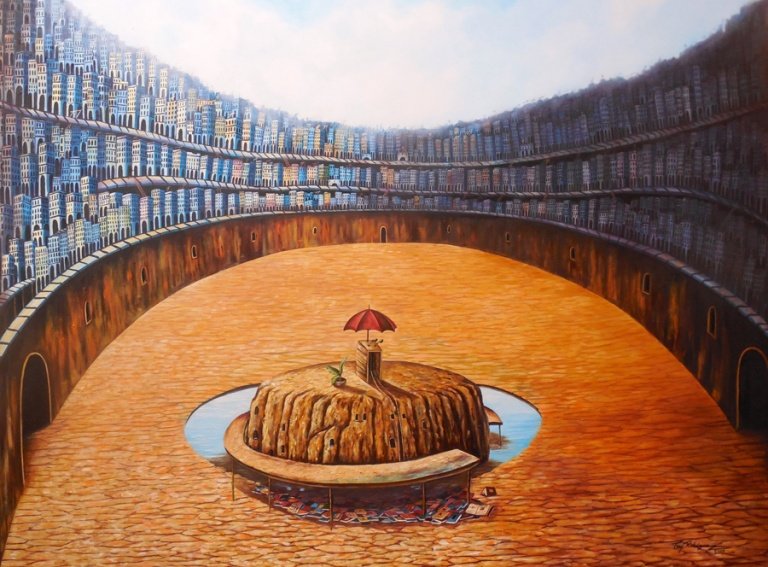
The work of Tony Rodríguez is part of a painting centralization that revokes any soliloquy, any inner dialogue. Everything is exteriorized, everything is public, like the very sensation of the somber loneliness.
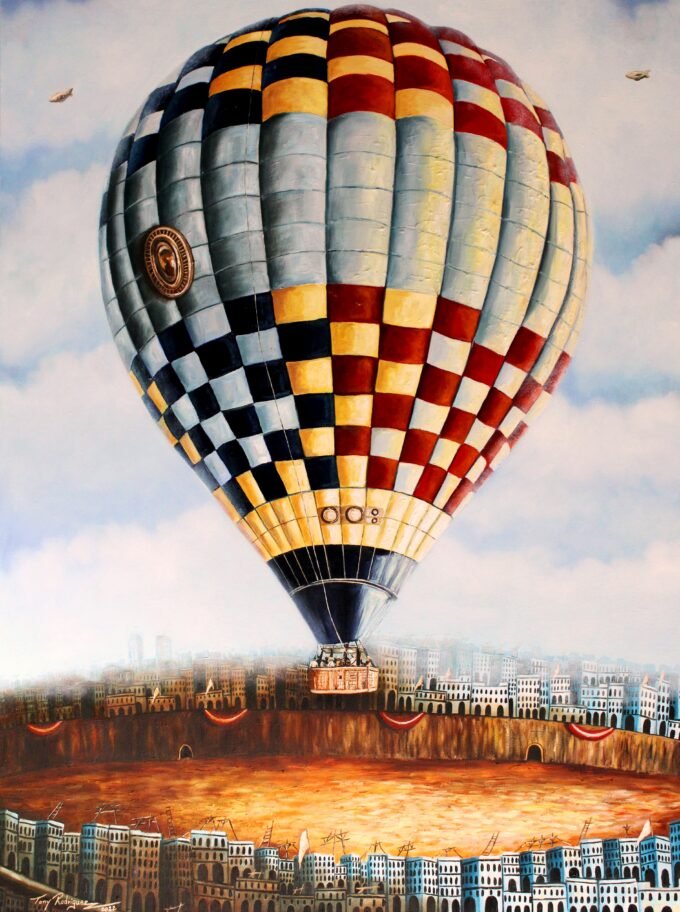
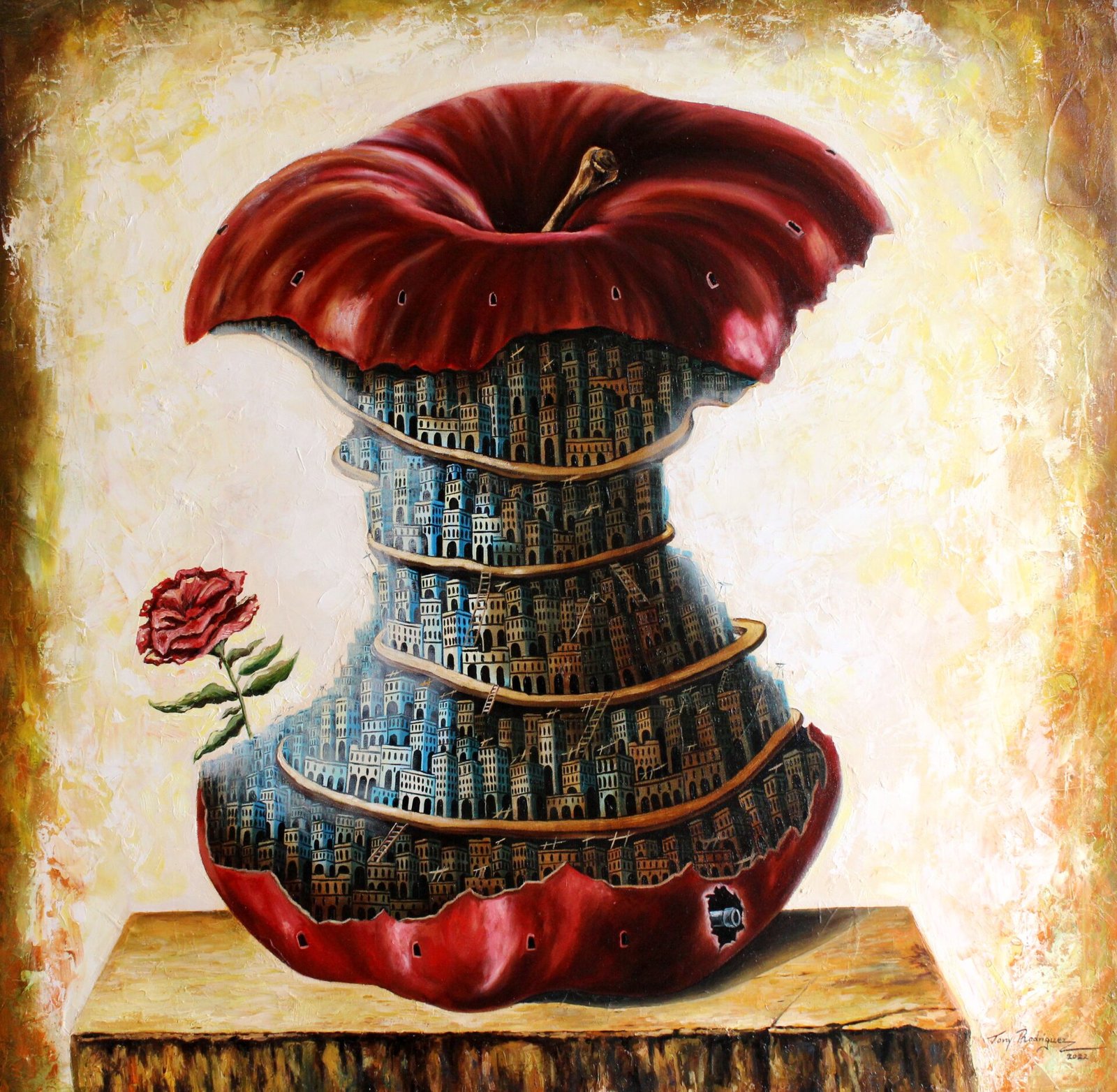
With always ochre shades and a skill in the symbolic synthesis, his iconography ends in an overabundance that reinforces the entity gravitating in the canvas center. Everything is suspended, reinforcing that ephemeral character that makes obstacles for the transcendental human will in culture. The recurrent centrality in the work of Antonio Rodríguez fixes a point of attention from which the entire visuality is organized. Everything gravitates around it, as if it were a curse. The chromatic handling of this centrality keeps away any vestige of hope; his palette, oriented toward the profound sepias, establishes a frame of mind that emphasizes on the decay, as in those photographs by Andrés Serrano at the morgue.
The neat care of the painting details is an element to be taken into consideration, since it underlines a frequently overlapped baroque. To cover the painting space is not an obsession; in any case, Tony Rodríguez saturates his canvas with details to emphasize the variegation and rust of a city that, like its actors, is decaying. The city of Juan Antonio Rodríguez, in any case, is a hybridized city just like culture, pastiche in its own reinvention; a reinvention that is not always kept in step with tradition, driven on above all by the survival in inexplicable balance.
The city of Antonio Rodríguez, like that of Ponte, of Pedro Juan Gutiérrez or the city of Dulce María Loynaz, is a ruined space where not only the city –architecture of a nation– decays, but also the subjects who inhabit it, the individual who remains. But the city of Antonio Rodríguez is also the panoptic city that causes madness, the watched over, watchful city that punishes, the city island, laboratory, surrounded by water.
Like few, Antonio Rodríguez reinforces –perhaps Tomás Sánchez may be the exception– the sense of insularity in painting. His work subtly emphasizes the determining factor of isolation in an oblique sense. Not only is the damned circumstance of water everywhere, but also the dark premonition, the “collective premonition of the end”. The island is not only surrounded by water; a flood of slogans overwhelms the insularity, fragile and frustrated with the revolutionary illusion.
The city-island present to such great extent in Tony Rodríguez’s painting had its parallel in the literature of Guillermo Cabrera Infante, who, obsessed by the style and rhythm of the city, points out a distinctive identity, plagued by whim and will. These elements introduce a narrative character in the painting of Tony Rodríguez that reinforces a search, a sort of archaeology of himself: how did we arrive to these conditions? How did we reach this pitiful state of decay?
This painting theatricality in the work of Tony Rodríguez is a binnacle, chromatic emphasis of the disillusion, “now that all illusions are dead…”, although at the same time it is a distrustful handling of the ambiguities and mirages. And it is so because Antonio Rodríguez’s painting is full of profound despair. The somber character, the profound discontent of his painting, the discouragement, the overcrowding, the misty existence of a man compete with a prudish production that, nourishing from trivial arguments, has a discourse of merely decorative background in painting and its curatorship..
Like the house –the island– in Jardín, the work of Juan Antonio Rodríguez also contains an ecumenical will, a sort of enlightening precaution. In its somber sadness, the work of Tony Rodríguez sparkles lights “… that once lit never extinguish, and that, displaced from all ends of the Earth, now arrive to break this quietness, to explore this loneliness.”