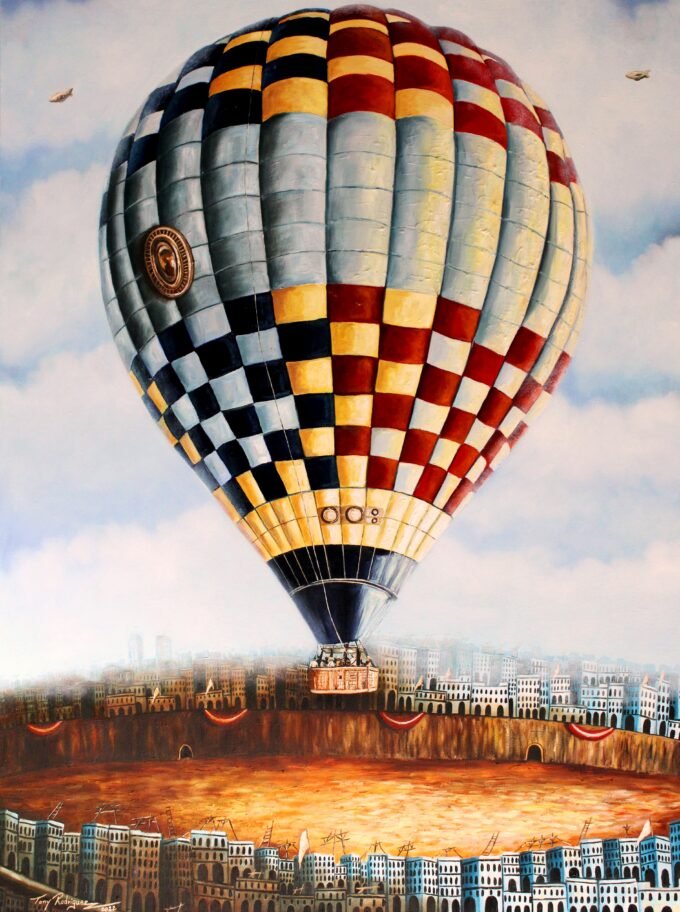
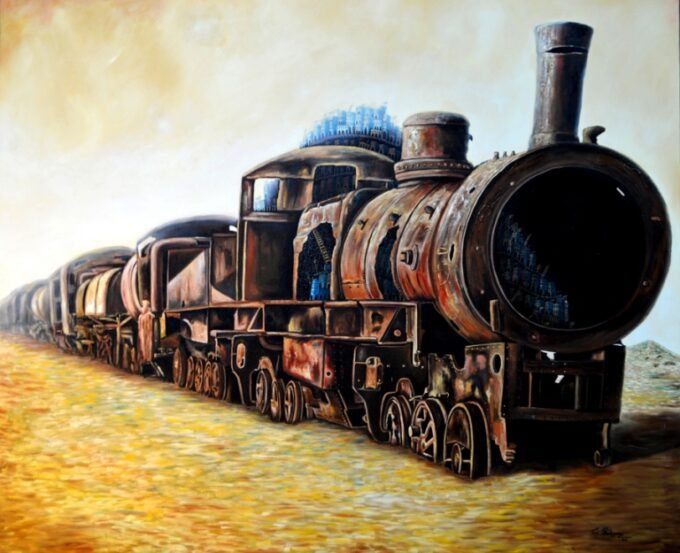
From the very beginning, the Cuban artist Tony Rodríguez understood that pictorial imagination can create forms—bearers, revitalizers, and generators of space—and images that, although mysterious and unprecedented, are no less real or concrete.
Thus, the material of his painting determines the effect it produces on the surface, becoming the source of those defined forms and the principal conduit of expression, even acquiring through it a tactile dimension.
The perception of that dazzling reality is revealed through a contrasted, blazing chromaticism that illuminates the existence of an unattainable sphere and of winged, ethereal figures who embody an infinity without end.
The presence of the roots and culture of his native island becomes evident through the materialization of a visual identity that encompasses a declaration of life and an evocation that moves between the chimerical, the dreamlike, the allegorical, and the sorrowfully utopian, accentuating the symbolic character of airborne beings—every one of them—carried away by their belief in the salvation of their future.
Thus, the artist undertakes, through his work, a journey into the presumably unknown, inviting us to participate with our gaze, guiding us beyond the boundaries of the individual through mechanical wings that point toward a destiny where uprootedness, hope, and life converge.
In this way, his figuration captures the precise moment of an event suspended between time and the boundless magnitude of space, and through it he summons us to focus on what seems essential from a before and the vision of an after, from the particular that extends to the universal and back again.
We are, therefore, before a worldview in which the artist has manifested, in these works, the sense of an adventure that pierces the pictorial skin and magically deciphers the path and movement of all he has embedded into the cosmos as a reality as mythical as it is authentic.
Which, in summary, leads us to define him as Goethe did, asserting that the most fitting artist in his genre is the one who unites his inventive capacity and imaginative power directly with the material with which he has worked.